- Home
- Media Center
- News & Press
- How sinit makes consistent use of digital assistance systems and the ENGEL iQ.boost Training program to achieve measurable savings
How sinit makes consistent use of digital assistance systems and the ENGEL iQ.boost Training program to achieve measurable savings
More expertise. Lower costs.
Digital assistance systems were already in place, but practical training was needed before used consistently. Today, sinit benefits from 50% fewer complaints, one-third fewer start-up parts, and annual savings of over $98,000.
At sinit’s injection molding facility in Rödental, materials, molds, and production requirements change daily. The facility handles more than 1,200 active products for industries ranging from electrical engineering to automotive and aerospace. Some products contain up to 60% glass fiber and must meet stringent flame-retardancy requirements. Twenty tie-bar-less ENGEL victory machines operate in production cells equipped with integrated viper linear robots and digital assistance systems, including iQ weight control, iQ clamp control, iQ flow control, and the shopfloor-monitoring function of the central production system.
However, sinit realized that the challenge went beyond the technology itself: all the digital assistance systems were in place, but they weren’t being used. Operators were unsure how to use them and hesitant to do so. Through ENGEL’s iQ.boost training, sinit bridged the gap between investing in the technology and realizing its full potential in series production.
Strategic Plastics Unit of Wöhner Industries Holding
sinit is part of Wöhner Industries Holding and is responsible for all plastics-related activities. “We are the Strategic Plastics Unit and cover everything from consulting on plastics-compatible assembly design and moldmaking to producing and assembling complete assemblies,” explains Alessandro Sattler, Director of Technical Operations at sinit. The Rödental site serves a broad range of markets. The electrical engineering sector, a key market with volatile demand, requires rapid availability and high quality standards. Other markets include automotive interiors, household goods, and the processing of high-performance polymers for safety-critical applications. “Ultimately, all markets have the same requirements: highly efficient manufacturing, high quality standards, and, above all, availability,” says Sattler.
Material Diversity and Wear: The Unique Challenge
At sinit, glass fiber content of up to 60 percent and flame-retardant additives are often combined. These materials pose specific production challenges. “Flame-retardant materials, in particular, are corrosive. Once the protective layer is compromised, wear—accelerated by the glass fiber—progresses very rapidly,” says Mike Stößel, head of plastics production at the Rödental site, describing the challenge. The plasticizing screws had a service life of only one and a half years.
Over an extended period, sinit worked with ENGEL to develop alternative wear-protection solutions. “We chose a different configuration and are now significantly exceeding the previous service life,” confirms Stößel. In addition, sinit uses a computed tomography scanner in its quality laboratory to perform microstructural analyses and mechanical component tests. This greatly reduces the time needed to analyze the causes of malfunctions.
Why a single machine manufacturer: 20 column-less ENGEL victory
sinit operates an all-ENGEL injection molding facility with clamping forces ranging from 500 to 3,000 kN. “Having just one manufacturer is a major advantage for the user. They don’t have to constantly switch between different control systems,” says Stößel, explaining the decision. With regular staff turnover and a shortage of skilled workers, this significantly shortens the training period for new employees. All production cells are equipped with viper linear robots, whose control systems are fully integrated into the machine control system: one operating system, one data backup system, and one user interface.
The tie-bar-less design of the victory series offers operational advantages with more than 1,200 active parts. “I have much more freedom in the tooling area, can utilize the full width of the clamping plates, and can even produce on machines with lower clamping force,” explains Stößel. In Rödental, low ceiling heights are an additional structural factor. “The tie-bar-less machine allows us to set up large molds in ways that would otherwise be impossible,” adds Sattler.
Digital Assistance Systems in Practice
ENGEL’s injection molding cells at sinit are equipped with the digital assistance systems iQ clamp control and iQ weight control. Their benefits are illustrated by a concrete example.
sinit conducted an internal comparison to determine clamping force. “We deliberately set up a little competition—operator versus machine—and found that the machine was able to determine the clamping force faster and more precisely,” reports Sattler. The energy consumption associated with the automatically determined clamping forces was, on average, 3 percent lower than with manually calculated settings. Added to this is an effect that cannot be directly quantified in energy figures: improved mold venting, resulting in less scrap. “With iQ clamp control, the result is independent of the operator—I always get the same result,” emphasizes Stößel. Especially with flame-retardant materials that tend to outgas, the improved venting through mold separation acts as an additional quality factor.
iQ weight control compensates for viscosity fluctuations even within the same shot. These fluctuations are caused not only by different batches but also by varying degrees of dryness, temperature differences, or drafts. “Thanks to the more stable processes, we have about one-third fewer start-up parts,” says Sattler, quantifying the result. For injection molding machines equipped with iQ weight control, sinit estimates savings of around $2,800 per machine per year, depending on the part, mold, and material—adding up to US$56,000 for a fleet of 20 machines equipped with this technology. For new machines, the company now orders the license directly at the time of purchase, depending on the application. Stößel articulates the overarching goal: “We want to be able to manufacture with the highest possible process reliability and unmanned operation.”
The Core Problem: Technology Available, but Not Used
sinit had invested in digital assistance systems, but they had not been activated on the production floor. The reason was not a technical hurdle, but operations’ uncertainty. “We realized that although we had the assistance systems, they weren’t being used. This was primarily due to our colleagues’ uncertainty and fear of making mistakes,” admits Sattler. Stößel sums up the problem: “There’s nothing worse than having high-tech equipment and only being able to use a fraction of it because people don’t know how to apply it safely and effectively.”
The solution was ENGEL’s iQ.boost training. The two-day program is designed for setup technicians, machine operators, and quality control personnel. It provides hands-on process know-how on the iQ assistance systems, combining theoretical fundamentals with guided commissioning and documented test runs on actual products. sinit has made the training a regular practice: first, traditional seminars at the ENGEL Training Center, followed by three iQ.boost sessions at its own plant in small groups of no more than five participants. “The difference was that it took place in-house. First on the virtual machine, then one and a half days of hands-on testing on our products. That way, everyone got a chance to try it out for themselves,” says Stößel, describing the process. At the end of each training session, sinit received a documented report detailing the measurable process improvements. “A PDF report that’s ready for management review,” says Stößel.
What Has Changed Since iQ.boost
The impact of iQ.boost is evident on several levels. The systems are now actually being used. “We’re seeing much greater confidence in using the systems, and the tools we have are now actually being utilized because employees understand how they work and what they do,” confirms Sattler. This immediately yielded a financial benefit for sinit, as the complaint rate was cut in half. And something else has changed that no report can capture: “Our goal is for users to be able to decide independently which system to use in which situation,” says Stößel, describing the transformation in manufacturing. Employees who were previously hesitant now actively and confidently make the right process decisions. “The training program is extremely important to us, and we will continue to rely on it in the future,” affirms Sattler.
Shopfloor monitoring: Real-time data as a common language
sinit uses ENGEL shopfloor monitoring to create the necessary transparency in production. For Stößel, as production manager, it provides the basis for daily performance evaluation: “Every company is interested in the causes of downtime, OEE, and the quality rate. For me, it’s important to quickly get an overview of how production is running.” Sattler adds to the organizational benefits: “The data is available in real time—anytime and from anywhere. This means everyone works with the same data, and we save several hours every day.” sinit has calculated exactly how much time this saves. Production management, production planning, and the three shift supervisors save time that was previously spent on manual data entry, follow-up inquiries, and walking around. In total, that amounts to three hours a day and, with 250 working days, about 750 hours a year. With an assumed hourly labor rate of $55, this corresponds to an economic benefit of around $40,000 annually.
A Partnership with Short Communication Channels
ENGEL understands sinit’s specific requirements. When configuring new production cells, ENGEL proactively points out equipment details that might otherwise be overlooked. “ENGEL knows exactly how we tick. They’ve really understood how we operate,” says Sattler, praising this collaborative approach. Even when it comes to special requests regarding peripherals, enclosures, or integrated automation solutions, sinit appreciates the flexibility of its injection molding solutions provider.
Thanks to the proximity of ENGEL’s facility in Nuremberg, service response times are usually less than 24 hours. Stößel gives an example: a valve failure on Thursday, a replacement part would normally not have been available until Tuesday, and the machine fully booked over the weekend. “The service technician offered to remove the valve from a machine at the technical center in Nuremberg. By the next morning, it was installed here and the machine was up and running again,” says Stößel. The lost production capacity over five days would have been nearly impossible to make up. It is in moments like these that the value of a reliable partnership becomes clear.
Conclusion
sinit demonstrates that investing in digital assistance systems is only the first step. A key factor is training operators. ENGEL’s iQ.boost training program has closed the gap at sinit between existing technology and its effective use in production. The complaint rate has been cut in half, start-up scrap has been reduced by one-third, employees can use the digital tools independently, and shop-floor monitoring delivers estimated annual savings of approximately $40,000. iQ weight control contributes an additional estimated $56,100 in annual savings. For sinit—a manufacturer with more than 1,200 active SKUs and a commitment to producing cost-effectively in Germany—this represents a tangible competitive advantage.
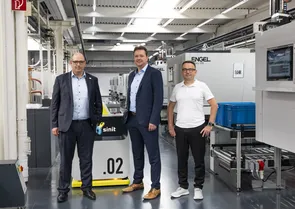
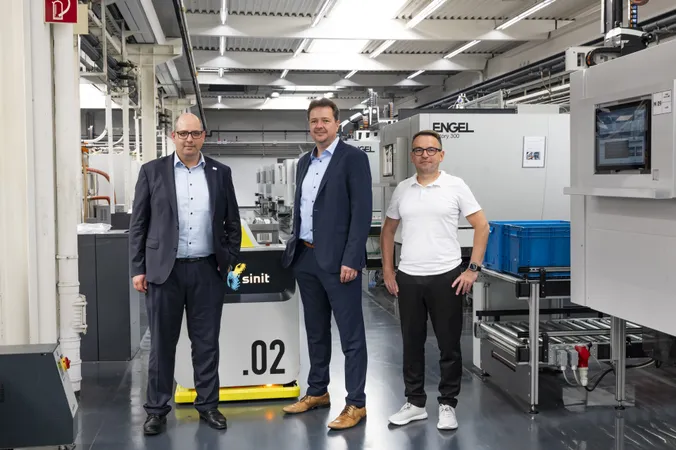
A Well-Coordinated Team: Alessandro Sattler, Director of Technical Operations at sinit; Tobias Theuerkauf from ENGEL Germany; and Mike Stößel, Head of Plastics Manufacturing at sinit (from left to right).
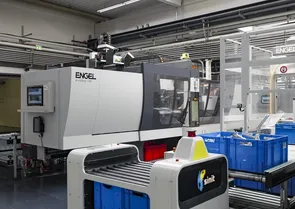
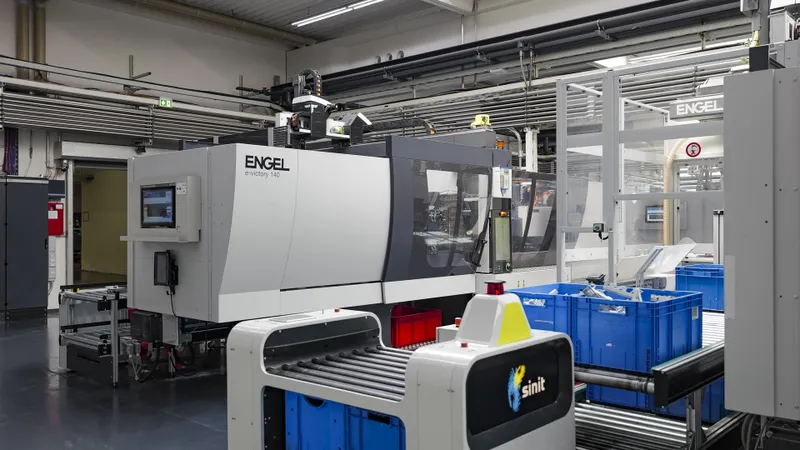
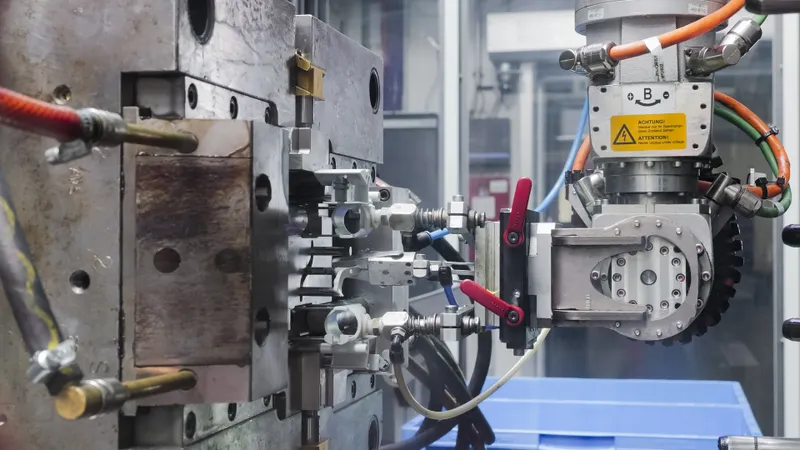
Production of electrical components on an e-victory 140.
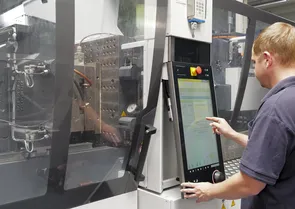
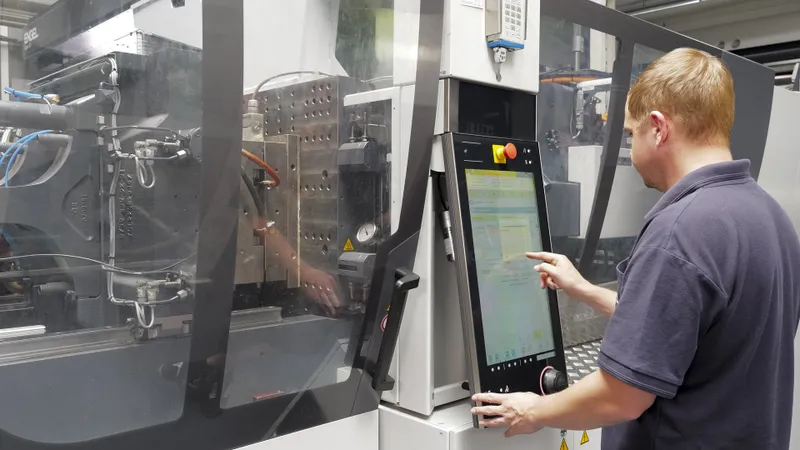
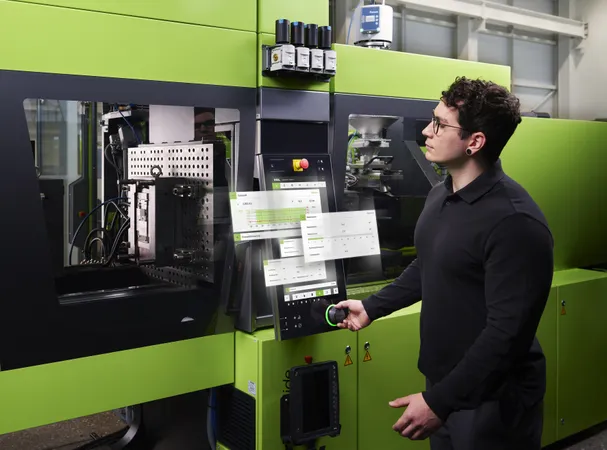
Setting process parameters for iQ weight control on the CC300 control system.
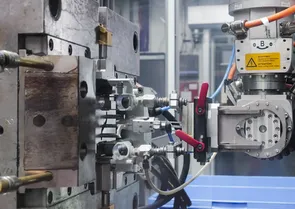
Manufacturing a fuse holder at sinit.
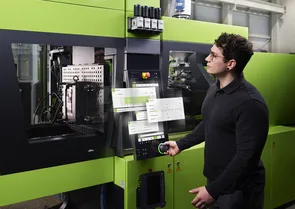
Digital solutions help optimize production processes and simplify day-to-day work at the machine.